Your existing data, configurations, and workflows remain unchanged.

QSEC Website Has Moved - Everything Else Stays the Same
Unchanged in operation. Expanded in possibility.
- QSEC continues unchanged as a dedicated governance, risk & compliance (GRC) solution with a strong capability in ISMS - plus the additional option to extend into identity governance and access management within the NEXIS platform.
What Has Changed - and What Has Not
QSEC remains unchanged in how it operates. There is no need for adjustments, and the same product, team and support structures remain in place.
QSEC continues to be available as an independent GRC solution. It can be used exactly as before, without any commitment to the broader platform.
What expands is the scope. As part of the NEXIS Platform, QSEC can now be connected with identity governance and access management. This enables a more integrated approach to aligning risk, compliance, and access decisions across systems - when required.
Your contacts, support, and customer access stay the same.
QSEC remains available as a standalone GRC solution.
QSEC can be extended into identity governance and IAM.
- Your existing data, configurations, and workflows remain in place.
- Your contacts, support, and customer access stay the same.
- The GRC capabilities you rely on continue to operate as before.
- Your current use cases and operational setup are still there.
Everything QSEC Covered. Now Integrated and Extended
NEXIS QSEC's GRC capabilities have been fully integrated into the NEXIS Platform. All four core disciplines are now available in one governed environment - connected to identity governance, AI-driven analytics, and continuous compliance monitoring that were not possible in a standalone GRC tool.
Governance & Compliance
Manage controls, audits, and measures in one system — from definition through evidence collection to reporting. Compliance requirements across DORA, NIS2, ISO 27001, BAIT, VAIT, and GDPR are mapped consistently on a shared foundation, with centralized document and evidence management eliminating duplicate work across frameworks. Automated reports are audit-ready and suitable for management. Adjacent topics such as incident management and measure tracking are integrated into the same governed model.
Enterprise & Cyber Risk Management
Structure enterprise and cyber risk across all hierarchy levels and organizational units in one governed model. Flexible assessment methods — qualitative, quantitative, and monetary — combined with configurable risk topic fields, KPIs, and aggregation logic cover the complete risk chain from identification to group-level roll-up. Best practices and automation support risk identification, with integration into other management systems enabling direct proposals and derivations.
Third-Party Risk Management
Maintain a centralized provider register that brings together all third-party relationships in one place – enhanced by automated self-assessment questionnaires, a dedicated third-party portal, and integrated outsourcing management. Gain full visibility across services, third-party risks, and your entire supply chain, enabling consistent governance and efficient risk oversight.
Information Security Management System (ISMS)
Build and operate a complete ISMS in one platform — from centralized data collection (processes, information systems, resources) through policy management, including creation, versioning, and distribution. Controls, audits, and reviews provide continuous evidence of measure effectiveness. Business continuity management processes are integrated directly, and the entire organization is involved through role-based, audience-specific interfaces.
Pre-Configured for the Frameworks That Matter in Your Industry
- DORA
- BAIT / VAIT
- PCI DSS v4.0
- NIS2
- BSI IT-Grundschutz
- SOX
- ISO 27001
- GDPR / DSGVO
- ISO 9001
DORA
NIS2
ISO 27001
BAIT / VAIT
BSI IT-Grundschutz
GDPR / DSGVO
PCI DSS v4.0
SOX
ISO 9001
GRC Without Identity Governance Is Half the Picture
Managing compliance risk and access risk in separate tools is one of the most common sources of audit findings, and one of the hardest problems to solve without a shared data foundation.
NEXIS connects both disciplines. Risk registers, SoD rules, third-party assessments, and compliance evidence are maintained alongside access governance, role lifecycle management, and identity security posture in one governed platform.
The result is not just a better GRC tool. It is a governance model where what you document and what you enforce stay aligned - continuously, not just before audits.
Frameworks
11 pre-configured regulatory frameworks including DORA, NIS2, ISO 27001, BAIT, VAIT, BSI IT-Grundschutz, GDPR, PCI DSS, SOX, Solvency II and IT-SiG 2.0.
AI-assisted
AI-assisted evidence collection combined with continuous compliance monitoring.
SoD Matrix
Cross-application SoD matrix — conflicts are detected before access is granted.
Third-Party Portal
Dedicated third-party portal with automated supplier self-assessments.
Proven at Scale
Trusted by more than 130 organizations across finance, insurance, manufacturing, and automotive.
EU-hosted SaaS or On-Prem
EU-hosted SaaS (Germany, Europe) or on-premises deployment available.
Proven in Practice
Over 130 organizations in regulated industries such as finance, insurance, manufacturing, and automotive rely on QSEC and now NEXIS.
See How NEXIS Supports a Continuously Compliant ISMS
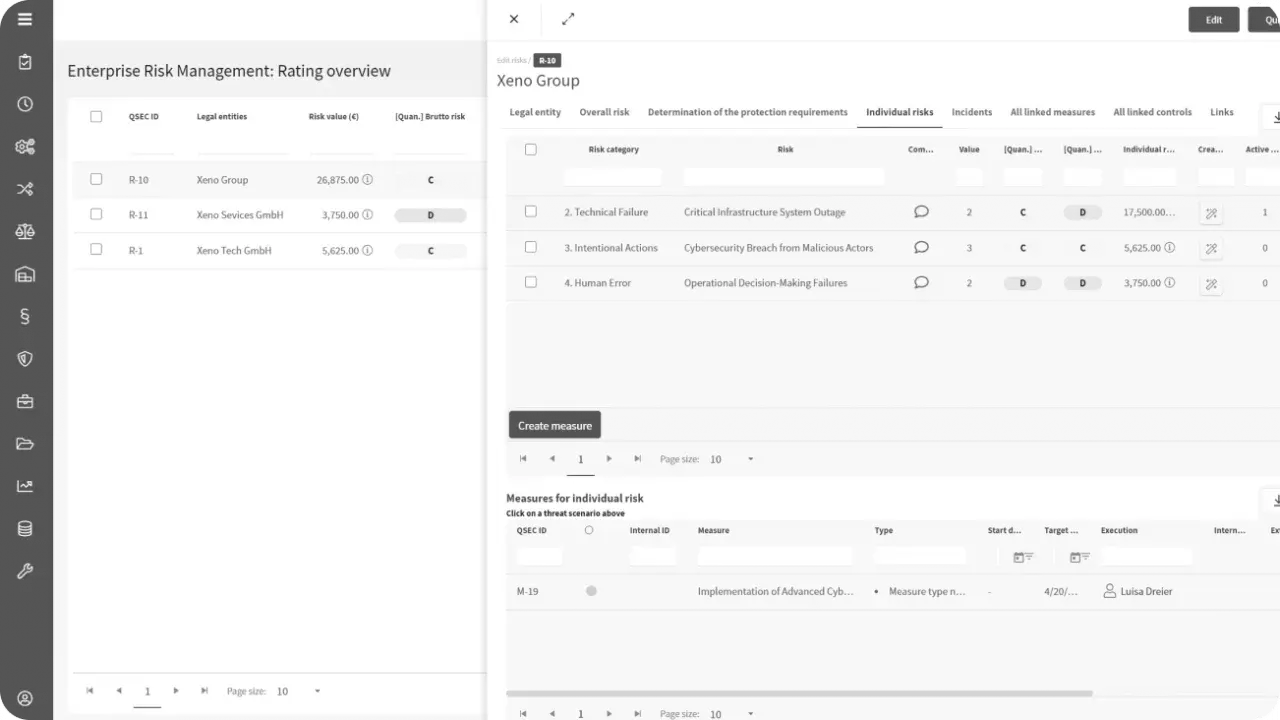
QSEC the integrated ISMS
See how organizations use NEXIS to build, maintain, and prove a continuously compliant information security management system.
Available on-premises, containerized (Docker/Kubernetes), or as EU-hosted SaaS. Demos run 45–60 minutes with a Nexis solution specialist.
Book a NEXIS QSEC Demo
See how QSEC, as part of NEXIS, supports governance, risk, compliance, and ISMS processes in one continuously governed platform.
In a session with a NEXIS solution specialist, you can review:
- How QSEC capabilities are now integrated into NEXIS;
- How your current GRC, ISMS, and third-party risk processes are supported;
- How identity governance and continuous compliance extend the former QSEC setup;
- Which deployment model fits your environment: EU-hosted SaaS, containerized deployment, or on-premises.
Prefer to explore first?